Melbourne · West, North, Inner East, Bayside & Both Growth Corridors
Foundation repair for Melbourne homes — stumps and slabs
Sloping floors, sticking doors, cracks marching up the brickwork. Two very different problems depending on what your house sits on — and we fix both. Restumping for older timber-floored homes, underpinning and slab-heave repair for slab-on-ground homes on reactive clay.
- Free on-site assessment
- Licensed builders, permits handled
- Written fixed price, no call-out fee
- Straight answer on whether you need work at all
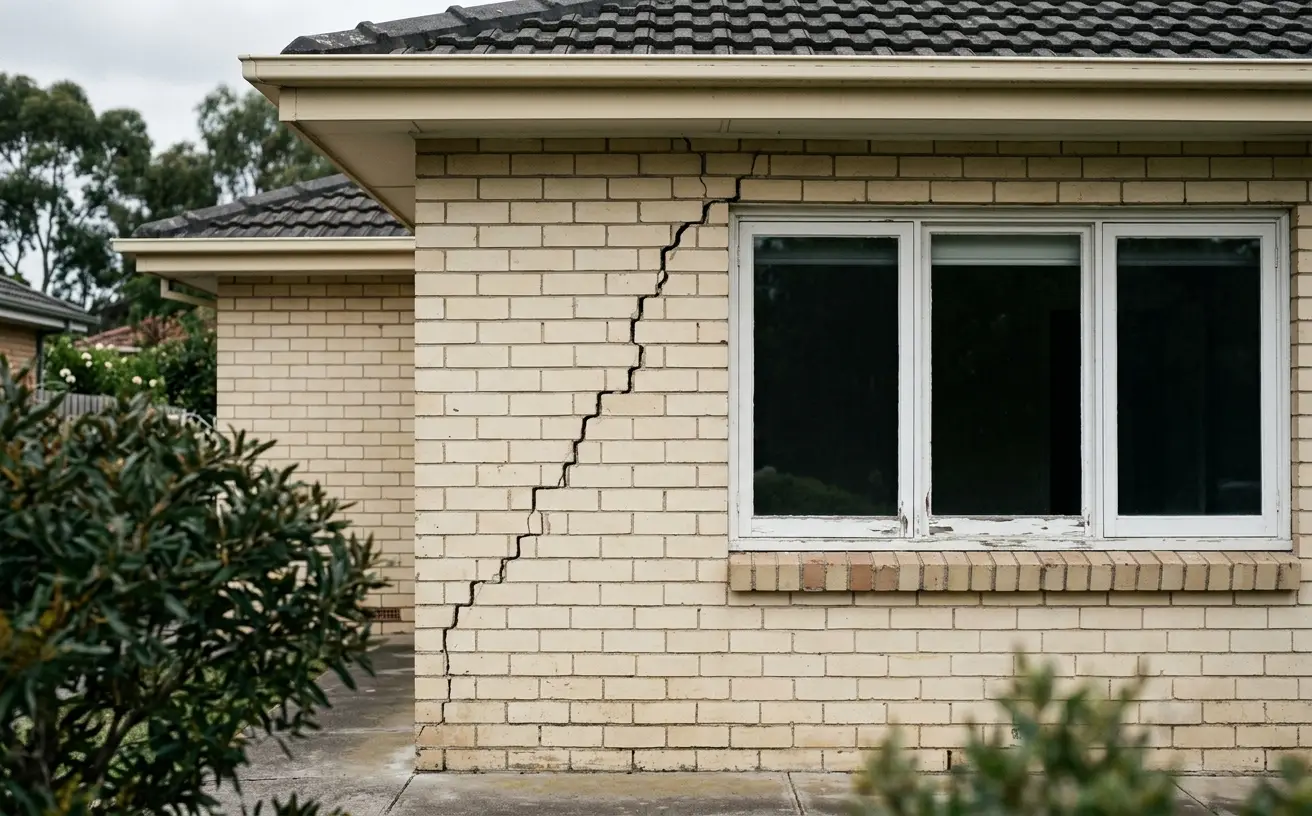
Start with the right service for your house
Getting this wrong is the most expensive mistake in foundation repair. A slab home cannot be restumped, and a stumped home does not need piers. Pick the description that matches yours.
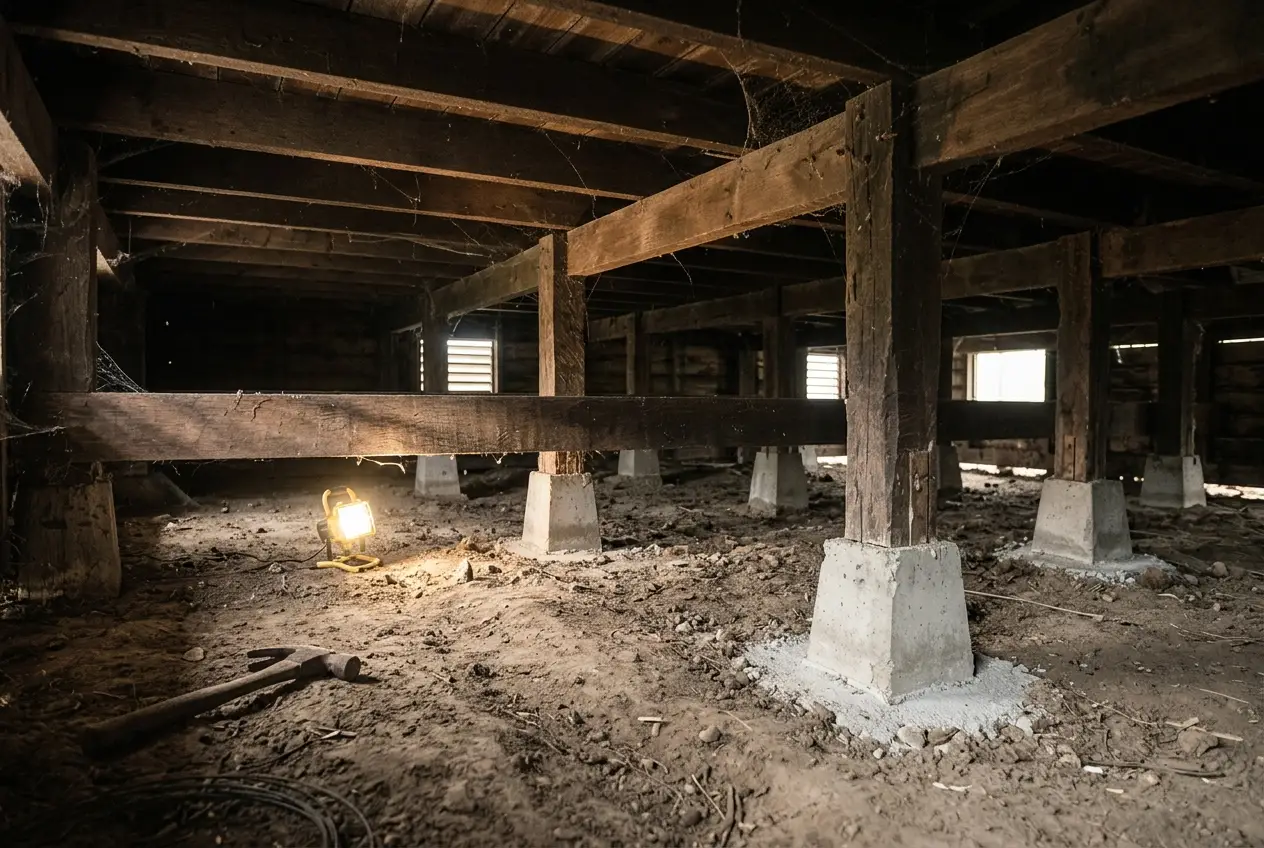
Restumping & Reblocking
For homes with a suspended timber floor on individual stumps — weatherboards, Edwardian cottages and California bungalows built before about 1970. Failed timber or concrete stumps are replaced and the floors re-levelled.
Typical signs: sloping or bouncy floors, gaps under skirting boards, doors catching at the top.
Restumping & reblocking →
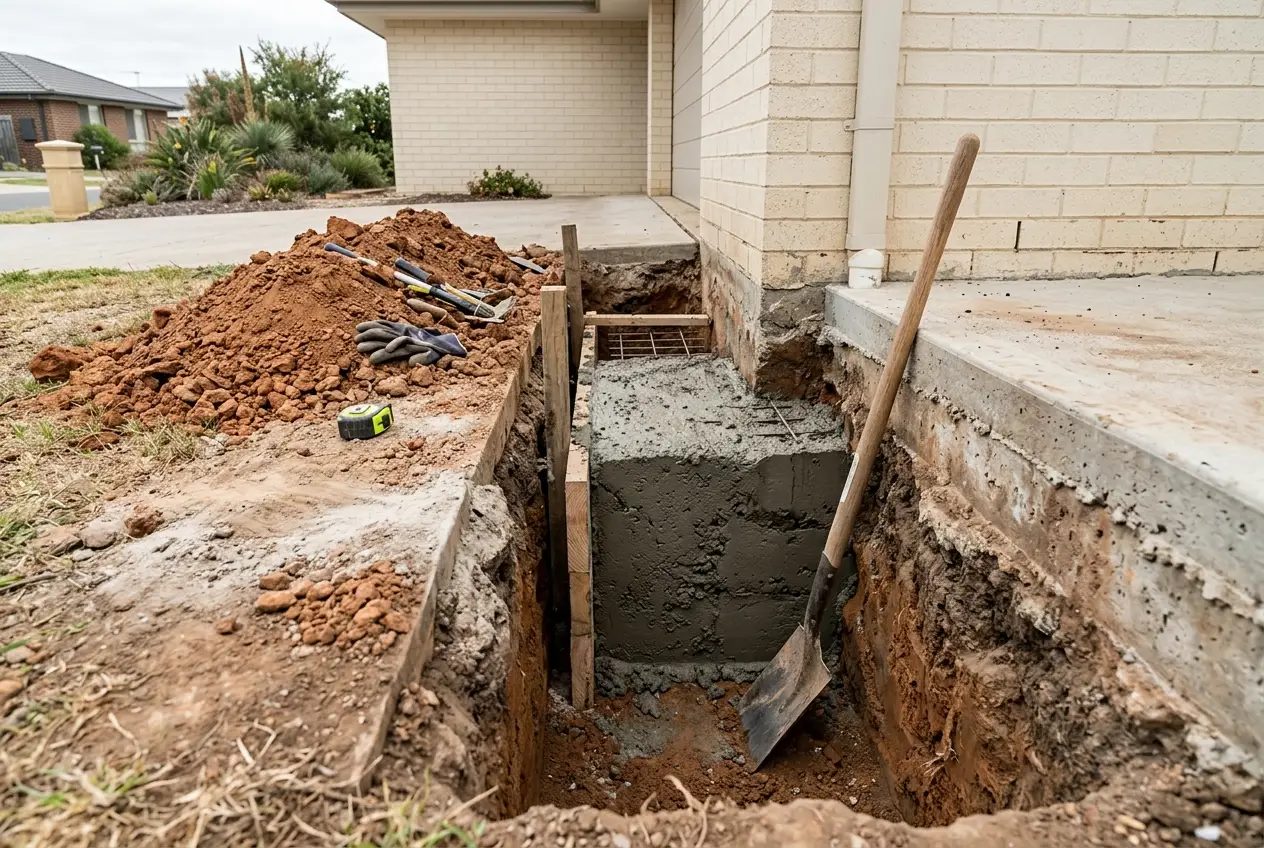
Underpinning & Foundation Repair
For brick-veneer homes on a concrete slab where the ground itself is moving — the norm across Melbourne's western growth corridor, where highly reactive clay swells and shrinks through every season.
Typical signs: stair-step cracks in brickwork, cracked floor tiles, gaps at the cornice.
Underpinning & foundation repair →
Related work we also do
Floor Levelling & Relevelling
Sloping, uneven and bouncy floors — measuring what has actually moved, then correcting it at the cause rather than packing the surface flat.
Start here if: the floor slopes, dips or bounces and nobody has yet told you why. We measure it before anyone quotes it.
Floor levelling & relevelling →
Slab Lifting & Concrete Levelling
Raising sunken driveways, paths, garage and patio slabs back to level with injected polyurethane resin — no breaking out, no repouring.
Start here if: the driveway, path or garage floor has dropped but the house itself is fine.
Slab lifting & concrete levelling →
- Leaning & Bowing WallsBowing brickwork, failed wall ties, lateral restraint
- Brick Repairs & RepointingCrack stitching, piecing-in, lime repointing
- Rising Damp TreatmentDamp at the base of walls — and what it usually really is
- Underpinning Methods ComparedMass concrete, bored piers, screw piles, resin
- ReblockingThe older Melbourne word for restumping
- What it all costsReal cost bands and how to compare two quotes
Areas we cover
Each suburb page covers the service that actually applies to that suburb's housing — not a generic page with the name swapped in.
Restumping suburbs — older stumped homes
- Restumping YarravilleInner West · $14,000 – $22,000 for a full restump
- Restumping FootscrayInner West · $12,000 – $20,000 for a full restump
- Restumping SeddonInner West · $13,000 – $21,000 for a full restump
- Restumping BrunswickInner North · $13,000 – $20,000 for a full restump
- Restumping CoburgInner North · $11,000 – $18,000 for a full restump
- Restumping SunshineWest · $11,000 – $18,000 for a full restump
- Restumping NorthcoteInner North · $13,000 – $21,000 for a full restump
- Restumping ThornburyInner North · $12,000 – $19,000 for a full restump
- Restumping PrestonInner North · $11,000 – $17,000 for a full restump
- Restumping ReservoirInner North · $10,500 – $16,500 for a full restump
- Restumping WilliamstownInner West · $14,000 – $23,000 for a full restump
- Restumping Moonee PondsInner North West · $13,000 – $22,000 for a full restump
- Restumping HawthornInner East · $16,000 – $30,000 for a full restump
- Restumping KewInner East · $18,000 – $34,000 for a full restump
- Restumping CamberwellInner East · $14,000 – $26,000 for a full restump
- Restumping Surrey HillsInner East · $13,000 – $24,000 for a full restump
- Restumping BrightonBayside · $18,000 – $34,000 for a full restump
- Restumping BentleighBayside · $12,000 – $21,000 for a full restump
- Restumping ElsternwickBayside · $13,000 – $23,000 for a full restump
- Restumping Box HillEastern Suburbs · $11,000 – $20,000 for a full restump
- Restumping BlackburnEastern Suburbs · $11,000 – $20,000 for a full restump
Underpinning suburbs — slab homes on reactive clay
- Underpinning Caroline SpringsWestern Growth Corridor · $15,000 – $35,000 for typical underpinning
- Underpinning MeltonWestern Growth Corridor · $18,000 – $40,000 for typical underpinning
- Underpinning Point CookWyndham · $15,000 – $32,000 for typical underpinning
- Underpinning TarneitWyndham · $16,000 – $38,000 for typical underpinning
- Underpinning WerribeeWyndham · $14,000 – $30,000 for typical underpinning
- Underpinning Hoppers CrossingWyndham · $12,000 – $28,000 for typical underpinning
- Underpinning TruganinaWyndham · $16,000 – $38,000 for typical underpinning
- Underpinning Taylors HillWestern Growth Corridor · $15,000 – $34,000 for typical underpinning
- Underpinning Deer ParkWest · $13,000 – $30,000 for typical underpinning
- Underpinning Wyndham ValeWyndham · $14,000 – $31,000 for typical underpinning
- Underpinning CairnleaWest · $16,000 – $34,000 for typical underpinning
- Underpinning Williams LandingWyndham · $15,000 – $32,000 for typical underpinning
- Underpinning Glen WaverleyEastern Suburbs · $18,000 – $38,000 for a typical underpinning job
- Underpinning BerwickSouth-East Growth Corridor · $18,000 – $40,000 for a typical underpinning job
- Underpinning Narre WarrenSouth-East Growth Corridor · $16,000 – $34,000 for a typical underpinning job
- Underpinning CranbourneSouth-East Growth Corridor · $16,000 – $36,000 for a typical underpinning job
- Underpinning Clyde NorthSouth-East Growth Corridor · $18,000 – $42,000 for a typical underpinning job
- Underpinning PakenhamSouth-East Growth Corridor · $16,000 – $34,000 for a typical underpinning job
Why Melbourne houses move
Almost every foundation problem in this city traces back to one thing: water changing the volume of clay soil. Melbourne's western and northern plains sit on basalt-derived clay that swells when it is wet and shrinks when it dries. Over a year the ground surface genuinely rises and falls, and anything founded in that top layer of soil rides up and down with it.
In older suburbs, that seasonal movement works on stumps that were set straight into the ground a century ago, alongside the slower problem of timber rotting at the ground line. In the newer estates, it works on slabs designed underAS 2870 to tolerate a calculated amount of movement — until a leaking drain, a garden bed watered daily against the house, or a large tree pulling moisture from one side upsets the balance and one part of the slab moves relative to the rest.
Which is why the first useful thing anyone can do is work out what is actually moving, and in which direction. We would rather tell you to fix a downpipe and watch it for a season than sell you piers you do not need.
Foundation repair in Melbourne — common questions
Do I need restumping or underpinning?
It comes down to what your house is built on. If it has a suspended timber floor sitting on individual stumps — typical of homes built before about 1970 — and those stumps have rotted or settled, that is restumping. If it is a brick-veneer home on a concrete slab and the ground beneath it is moving, that is underpinning. Melbourne is split fairly cleanly: the older inner-west and inner-north suburbs are stumped, while the growth-corridor estates west of Sunshine are all slab-on-ground.
What does foundation repair cost in Melbourne?
A full restump of a standard three-bedroom weatherboard typically runs $11,000 to $22,000 depending on access, with tight inner-west blocks at the top of that range because every stump is hand-dug. Underpinning is priced per pier, commonly $1,500 to $3,500 each, with most jobs needing eight to fifteen piers — so $15,000 to $40,000. Resin injection can stabilise minor slab movement for $5,000 to $15,000. Every one of those is an indicative range; a fixed price follows an on-site inspection.
How do I know if cracking in my house is serious?
Two things matter more than crack width: direction and behaviour over time. Diagonal or stair-step cracks following mortar joints, cracks wider at one end than the other, and cracks that keep widening month after month indicate structural movement. Hairline cracks in plaster that stay the same size, and cracks that open in summer and close again in winter, usually indicate normal seasonal movement. If you are unsure, mark each end of the crack with a pencil and the date, then look again in three months — that simple record tells an engineer more than a single photo ever will.
Do you need a building permit for foundation work in Victoria?
Yes for restumping and reblocking, which is building work requiring a permit from a registered building surveyor and a registered building practitioner to carry it out. Underpinning generally requires a permit as well, and usually an engineer-designed solution. Minor crack repair and resin injection may not, depending on scope. Any contractor who tells you a full restump or underpin does not need a permit is telling you something that should end the conversation.
How long does foundation repair take?
A full restump is typically one to two weeks on site, longer where access forces hand digging. Underpinning is usually one to three weeks depending on pier count and depth, plus curing time before the load is transferred. Add two to four weeks beforehand for permits and engineering. Most homeowners can stay in the house throughout — the work happens underneath and outside.